
Beyond Fireworks: What Drone Shows Reveal About the Future of City Technology
Updated: Jul 24

Fireworks aren’t the only show in town anymore.
For generations, they’ve been part of how communities celebrate: loud, bright, familiar and deeply tied to civic tradition. But across Arizona and the country, more cities are starting to experiment with a different kind of night sky.
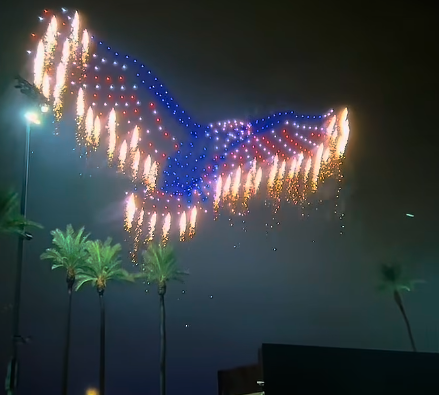
Drone light shows are showing up at Fourth of July events, New Year’s Eve celebrations and large public gatherings, offering cities a new way to create a shared experience without relying entirely on fireworks.
In Arizona, that shift is already visible. Flagstaff brought back its Fourth of July drone show in 2026, continuing a model that fits especially well in a community where wildfire risk is always part of the summer conversation.
Phoenix featured a drone light show at Deer Valley Park as part of its After Dark in the Park celebration.
Goodyear’s Star Spangled Fourth celebration included hundreds of synchronized drones creating patriotic images across the night sky.
And in Tucson, the city is preparing to replace its long-running “A” Mountain fireworks tradition with drones beginning in 2027.Drone shows are fun, memorable and easy for the public to understand. But they’re also a marker of something bigger: aerial technology is moving quickly from novelty to everyday use, with retailers, logistics companies, healthcare organizations and public agencies all experimenting with drones in different ways.
Cities will increasingly have to manage that shift, and many of the most important questions — airspace, safety, privacy, data, procurement and public communication — don’t stop at city boundaries.
Drone shows are one of the most public, visible and accessible examples of a broader shift already underway in municipal operations. Cities aren’t just looking at new tools because they’re flashy or futuristic. They’re asking whether those tools can reduce risk, improve public experience, support staff and create long-term civic value.
Why Cities Are Taking a Closer Look
The practical appeal is clear. In places where wildfire risk is a constant concern, drones can reduce accidental ignition risk while avoiding the smoke, debris and explosive noise associated with traditional fireworks. They can also make public celebrations more accessible for residents with pets, young children or sensory sensitivities, while giving cities more flexibility to tell a local story through images, symbols and coordinated messages in the sky.
Recent large-scale displays, like the 2,500-drone patriotic show over North Texas, show how quickly the technology is moving from novelty to mainstream public spectacle.
Still, this shouldn’t be treated as a simple replacement story. Fireworks remain meaningful to many communities, and drone shows come with their own limitations, including cost, weather, visibility, vendor availability and technical complexity.
So the question isn’t, “Should every city replace fireworks with drones?”
A better question is, “How should cities evaluate a new technology when it starts to become a real option?”
That’s where this conversation gets more important.
From Celebration to Everyday Civic Life
For many residents, a holiday drone show may be one of their first positive experiences with drone technology in a civic setting. That matters because drones are often discussed in much more sensitive contexts: surveillance, privacy, law enforcement, emergency response and airspace restrictions. A community celebration creates a softer entry point. It gives residents a chance to see coordinated aerial technology used for something shared, visible and non-threatening.

But that doesn’t erase the harder questions. It just creates a more constructive place to start asking them.
And cities will need to ask those questions soon, because drones are already moving beyond entertainment and into everyday life. Retailers are testing drone delivery, healthcare and pharmaceutical companies are exploring ways to move time-sensitive supplies, logistics companies are looking at aerial delivery, and public agencies are evaluating drones for emergency response, infrastructure inspection, wildfire monitoring and disaster assessment.
A drone light show is not the same thing as a delivery drone, a public safety drone or a drone used by public works crews. But it does help people picture what coordinated aerial systems can make possible — and it gives cities a visible starting point for a much larger conversation.
Drones can support infrastructure inspection, storm damage assessment, wildfire monitoring, traffic and event management, environmental observation, disaster response and public safety operations.
For Arizona, those possibilities aren’t abstract. Communities across the state are dealing with extreme heat, wildfire risk, rapid growth, major public events, aging infrastructure and more complex emergency management needs.
At the same time, cities may soon need to respond not only to their own drone programs, but to private-sector drone activity above neighborhoods, commercial corridors, medical campuses and logistics routes.
The Real Work Is Governance
Cities shouldn’t adopt drones just because they’re new, impressive or visually compelling. The real work is governance: defining the problem, understanding FAA requirements, planning for safety, selecting qualified vendors, managing insurance and liability, and coordinating with police, fire, parks, transportation and emergency management teams.
Just as important, that governance can’t happen city by city alone. Drones don’t stop neatly at municipal boundaries, and issues like airspace, emergency response, procurement standards, vendor accountability, data policies and public communication all benefit from regional alignment.
A regional strategy matters. That’s where Greater Phoenix Connective can play a valuable role.
Connective’s job isn’t to tell every city to adopt drones. It’s also not to promote any single vendor or use case. The value is in helping cities evaluate what’s possible, understand what risks need to be managed and work together on practical standards that build public trust.
That means bringing city leaders, technology experts, public safety officials and regional partners into the same conversation before decisions are made in isolation.
It means helping communities move past the hype and focus on the fundamentals: What problem are we solving? What guardrails do we need? How will this improve outcomes for residents? How do we make sure the public understands what’s being done and why?
What the Sky Is Really Showing Us
The lights in the sky may be what capture everyone’s attention. But the bigger question is what comes next?
Drone shows may start as an alternative to fireworks. Their larger significance is what they reveal about the future of city technology. The question isn’t simply whether cities should use drones. It’s how they should evaluate, govern and deploy emerging tools in ways that reduce risk, improve operations and strengthen community trust.
The next generation of civic technology won’t be judged by how impressive it looks on opening night.
It’ll be judged by whether it helps cities make better decisions, serve residents more effectively and build confidence while doing it.